
What Is a Light Adjustable Lens?
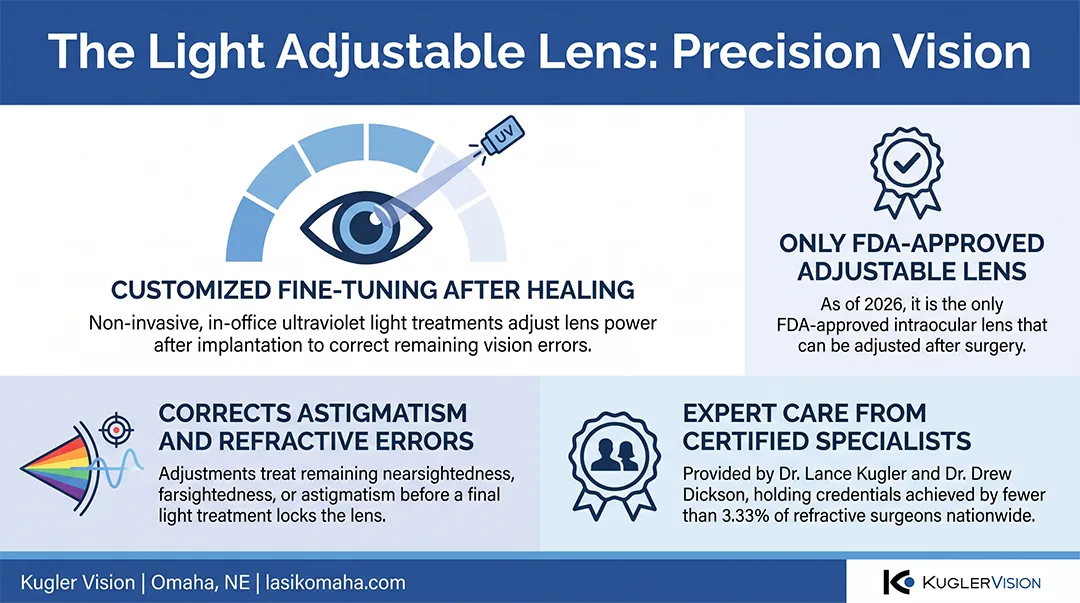
A Light Adjustable Lens is an artificial lens implanted during Refractive Lens Exchange or cataract surgery that can be fine-tuned after the eye heals. It is made of a light-sensitive material, so in-office ultraviolet light treatments can change its power to correct remaining nearsightedness, farsightedness, or astigmatism. A final treatment locks the lens. As of 2026, it is the only FDA-approved intraocular lens that can be adjusted after implantation.
Kugler Vision in Omaha offers the Light Adjustable Lens for Refractive Lens Exchange and cataract surgery through its two surgeons, Lance Kugler, MD, PCEO, and Drew Dickson, MD, PCEO. Both are Fellows of the World College of Refractive Surgery and Visual Sciences, a credential held by fewer than 3.33% of refractive surgeons nationwide.
Can a Light Adjustable Lens Be Used in Refractive Lens Exchange?
Yes, surgeons use the Light Adjustable Lens in Refractive Lens Exchange, where a clear natural lens is replaced, as well as in cataract surgery. Its FDA approval covers use after a cataract is removed, so Refractive Lens Exchange use falls outside its approved labeling and rests on the surgeon’s medical judgment. A full eye evaluation determines eligibility.
Kugler Vision in Omaha performs Refractive Lens Exchange for patients 50 and older and uses the Light Adjustable Lens regularly in those procedures. Lance Kugler, MD, PCEO, and Drew Dickson, MD, PCEO, determine during each evaluation whether an adjustable lens or a fixed premium lens fits each patient’s eyes and vision goals.
How Is a Light Adjustable Lens Different From a Standard Monofocal Lens Implant?
The main difference is timing: a standard monofocal lens has its power chosen before surgery and cannot be changed afterward, while a Light Adjustable Lens can be refined after the eye heals. Both focus at one distance. In the randomized FDA study of about 600 cataract patients, those with the Light Adjustable Lens were about twice as likely to see 20/20 without glasses at six months.
Kugler Vision, the first provider in Omaha offering all 7 vision correction procedures, offers the Light Adjustable Lens alongside monofocal, toric, multifocal, and extended depth of focus lenses for Refractive Lens Exchange and cataract surgery, so Dr. Kugler and Dr. Dickson can match the lens to each patient’s measurements and vision goals.
How Does the Light Adjustment Work After Surgery?
After Refractive Lens Exchange or cataract surgery, the eye heals for about two to three weeks, and then vision is measured to find any remaining prescription. The patient sits at an in-office Light Delivery Device, which shines a programmed pattern of ultraviolet light onto the lens for a brief treatment, often about 90 seconds, changing the lens shape and power. The adjustment is noninvasive, with no incision.
At Kugler Vision, light adjustment visits take place in the practice’s own office with the same surgical team that implanted the lens. Drew Dickson, MD, PCEO, completed his residency at the Storm Eye Institute, a top-10 program, before his refractive surgery fellowship under Dr. Kugler.
Am I a candidate?
Take our quick vision quiz. Over 80% of patients who were told ‘no’ elsewhere find a solution here.
2 Minutes
How Many Light Treatments Does It Take Before the Lens Is Locked In?
Treatment plans typically include two to five light treatments: one or more adjustments, spaced 1-2 weeks apart, followed by two final lock-in treatments. FDA labeling requires at least one adjustment and two lock-ins, beginning 30-60 days after the lens is implanted. After lock-in, the lens power is set. Light exposure no longer changes the lens.
Kugler Vision schedules lens surgery follow-up visits at one day, one week, one month, three months, and six months, and light treatments are built into that schedule, so the light adjustment specialist team checks each adjustment against measured vision before the lens is locked in.
Do You Need to Wear UV-Protective Glasses Until the Final Lock-In?
Yes. Patients wear special UV-protective glasses, supplied by the practice, during all waking hours from lens implantation until 24 hours after the final lock-in treatment. Unprotected exposure to sunlight or indoor ultraviolet light before lock-in can change the lens power unpredictably. Once the lens is locked in, the protective glasses are no longer needed for the lens.
Kugler Vision patients travel from 47 states and several countries, so out-of-town Light Adjustable Lens patients plan for several return visits to Omaha between surgery and lock-in. The care team maps that visit schedule during the consultation so travel can be arranged in advance.
How Does the Light Adjustable Lens Compare With Other Premium Lens Options?
The Light Adjustable Lens stands apart from other premium lenses because its power can be refined after surgery, while toric, multifocal, and extended depth of focus lenses have fixed designs chosen beforehand. Multifocal and extended depth of focus lenses spread focus across distances to reduce reading-glass use. The Light Adjustable Lens focuses at one distance per eye. That distance can be set after healing.
Lance Kugler, MD, PCEO, served as Director of Refractive Surgery at the University of Nebraska Medical Center and has published on Refractive Lens Exchange and premium lens selection. He and Dr. Dickson compare the Light Adjustable Lens with fixed premium lenses for each patient at Kugler Vision.
How Medicare and insurance treat premium lens upgrades, including the Light Adjustable Lens, is explained in the guide to Refractive Lens Exchange costs versus waiting for cataracts.
Who Is a Candidate for a Light Adjustable Lens, and Who Is Not?
Light Adjustable Lens candidates include adults having Refractive Lens Exchange or cataract surgery, and FDA labeling covers cataract patients with at least 0.75 diopters of corneal astigmatism and no preexisting macular disease. Some patients are not candidates. They include anyone taking UV-sensitizing or retina-toxic medications, anyone with a history of herpes infection in the eye or with nystagmus, and anyone unable to wear UV-protective glasses until lock-in and attend every light treatment.
Prior LASIK makes lens power calculations less predictable, so Dr. Kugler and Dr. Dickson may consider the Light Adjustable Lens for patients who had LASIK years ago and now want Refractive Lens Exchange or need cataract surgery. Kugler Vision, 11 years voted Best of Omaha, reviews prior LASIK records during the evaluation.
Communities Served
Kugler Vision is located at 17838 Burke St., Suite 100, in Omaha, Nebraska. Patients come from Omaha, Lincoln, Bellevue, and Council Bluffs, and from 47 states and several countries.
Light Adjustable Lens candidacy for Refractive Lens Exchange or cataract surgery is confirmed through detailed eye measurements and a full evaluation. Book a consultation at Kugler Vision in Omaha to learn whether an adjustable lens fits your eyes.
Related Resources
- Refractive Lens Exchange at Kugler Vision
- All 7 vision correction procedures at Kugler Vision
- Laser cataract surgery and premium lens selection
Medically Reviewed By:
Lance Kugler, MD, Board-Certified Ophthalmologist
Fellowship-Trained Refractive Surgeon
Last reviewed October 13, 2026

Dr. Drew Dickson is a board-certified ophthalmologist who specializes in LASIK and other refractive surgery procedures. He completed his undergraduate studies at Liberty University before earning his medical degree from the University of Nebraska Medical Center College of Medicine. He then completed his ophthalmology residency at the Medical University of South Carolina Storm Eye Institute.
In addition to his clinical practice, Dr. Dickson is involved in research and has published numerous articles in peer-reviewed journals. Dr. Dickson is known for his compassionate bedside manner and commitment to providing his patients with personalized care. In his free time, he enjoys spending time with his family and traveling.