
The math behind “just wait for cataracts” rarely gets walked through in full. For RLE-eligible candidates evaluating a financial decision, the cost-timeline picture between today and age 65 (or later) often differs from initial expectations.
Is Refractive Lens Exchange Cheaper Than Waiting for Cataracts?
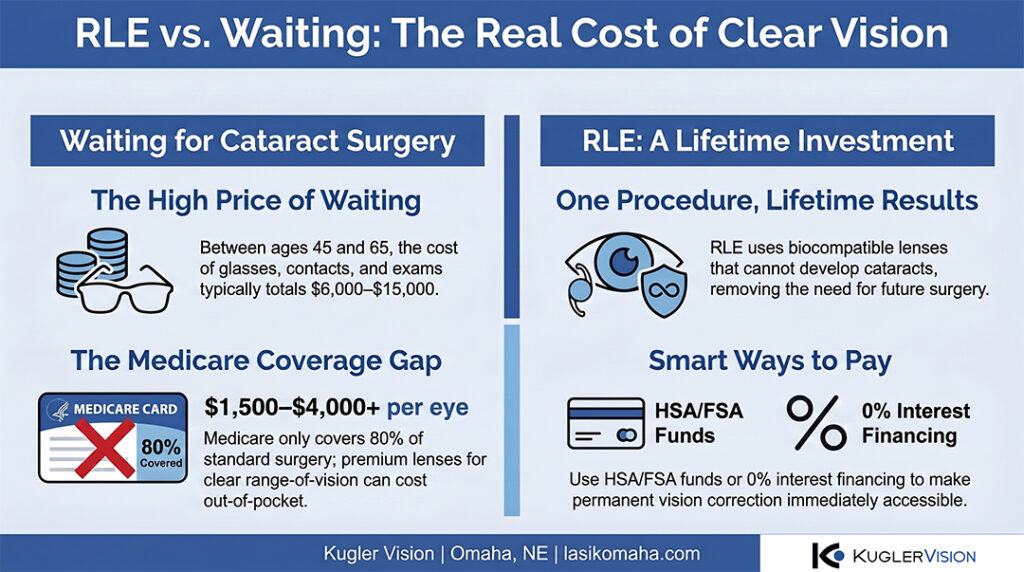
As of 2026, for most RLE-eligible candidates, waiting for cataracts does not save as much money as it appears. Medicare covers 80% of standard cataract surgery with a basic monofocal lens, but patients who want the same visual range RLE provides still pay out-of-pocket for premium lens upgrades, coinsurance, and 15–25 years of glasses, contacts, and eye exams during the waiting period.
Kugler Vision in Omaha is led by Dr. Lance Kugler, MD, founder and author of a peer-reviewed chapter on refractive lens exchange diagnostics published by SLACK Incorporated. The practice was the first in Nebraska to offer all seven modern vision correction procedures.
Does Medicare actually cover cataract surgery in full?
No. Medicare Part B covers 80% of the approved amount for standard cataract surgery after the annual deductible, which was approximately $283–$288 in 2026. Patients pay the remaining 20% coinsurance and 100% of premium lens upgrades — multifocal, toric, EDOF, and Light Adjustable Lens implants are excluded from Medicare coverage.
RLE candidates at Kugler Vision frequently ask whether Medicare will cover a similar procedure later. The practice walks each patient through the full cost math during a consultation before any treatment decision is made.
What’s the 2026 out-of-pocket cost of cataract surgery with a premium IOL?
In 2026, standard Medicare-covered cataract surgery with a monofocal lens typically costs $380–$590 per eye out-of-pocket after the deductible. A premium intraocular lens upgrade — multifocal, toric, EDOF, or Light Adjustable Lens — adds approximately $1,500–$4,000+ per eye out-of-pocket on top of that amount. Laser-assisted cataract surgery performed for refractive goals may not be Medicare-covered.
The premium lens upgrade cost is where the “wait for Medicare” and cataracts math begins to converge with RLE pricing. Kugler Vision offers these same lens technologies during RLE, with financing available through Alphaeon Credit at 0% interest for qualifying patients. Information on laser cataract surgery is available separately.
How much do glasses, contacts, and annual eye exams cost between ages 45 and 65?
Between ages 45 and 65, progressive or bifocal glasses cost approximately $250–$500+ per pair and are typically replaced every 1–2 years. Contact lenses run $220–$500 annually plus solution and accessories. Comprehensive eye exams cost $100–$250 per year. Over a 15–25 year waiting period, these combined costs commonly total $6,000–$15,000+, depending on prescription complexity.
Many RLE candidates at Kugler Vision reference their past decade of eyewear receipts, which make the lifetime-cost comparison concrete rather than theoretical. The EyeAnalysis consultation and exam includes full RLE candidacy screening.
Am I a candidate?
Take our quick vision quiz. Over 80% of patients who were told ‘no’ elsewhere find a solution here.
2 Minutes
What are the three stages of Dysfunctional Lens Syndrome (DLS)?
Dysfunctional Lens Syndrome (DLS) is a three-stage clinical framework describing age-related changes in the eye’s natural lens. Stage 1 is presbyopia, the loss of near focus typically beginning in the mid-40s. Stage 2 involves lens yellowing and reduced light transmission, often starting in the mid-50s. Stage 3 is cataract formation, where the lens becomes cloudy enough to significantly impair vision.
Lance Kugler, MD — Fellow of the World College of Refractive Surgery and author of a peer-reviewed chapter on RLE diagnostics published by SLACK Incorporated — applies the DLS framework at Kugler Vision. Drew Dickson, MD, also a Fellow of the World College of Refractive Surgery, also evaluates candidates across all DLS stages.
Is RLE surgery riskier when performed before cataracts develop?
RLE is not inherently riskier when performed before cataracts develop. Clinical evidence suggests clearer, younger lenses can be easier to work with surgically than mature cataracts, and the core surgical technique is substantially the same. Both RLE and cataract surgery share common risks, including posterior capsule opacification, which is treated with a brief YAG laser capsulotomy rather than a second surgery.
Kugler Vision uses a comprehensive EyeAnalysis diagnostic workup to screen every RLE candidate. Patients who are not suitable candidates — including those with unstable refractive conditions or certain retinal concerns — are redirected to the appropriate alternative rather than cleared for surgery.
Can I use HSA, FSA, or financing for RLE to offset the upfront cost?
Yes. RLE qualifies as a medical expense under both HSA (Health Savings Account) and FSA (Flexible Spending Account) rules, effectively reducing the procedure cost by the patient’s applicable tax rate. Medical financing — including 0% interest terms through specialized medical lenders — allows RLE to be paid over 12–60 months rather than as a single upfront expense.
Kugler Vision in Omaha offers Alphaeon Credit financing with 0% interest terms for qualifying patients, along with HSA and FSA acceptance. The practice publishes RLE financing details and no hidden fees on consultation or treatment pricing.
How does RLE eliminate the need for future cataract surgery?
The intraocular lens (IOL) implanted during RLE is made of synthetic biocompatible material that cannot develop cataracts. Because a cataract is a clouding of the eye’s natural lens, removing that lens during RLE — at any adult age — means cataracts cannot form in the replaced lens. Posterior capsule opacification remains possible but is treated with an outpatient YAG laser capsulotomy, not a second surgery.
For Kugler Vision patients, this durability is often the deciding factor. RLE is designed to provide long-lasting vision correction without the future need for cataract surgery on the treated eye, though annual eye exams remain part of routine care at any age.
What does an RLE consultation at Kugler Vision in Omaha cost?
The RLE consultation at Kugler Vision in Omaha includes a full diagnostic workup, Dysfunctional Lens Syndrome (DLS) staging assessment, and a review of lens technology options — monofocal, multifocal, EDOF, and Light Adjustable Lens. Personalized RLE pricing is provided at the end of the consultation based on prescription complexity, selected lens technology, and applicable financing or HSA/FSA offsets. The consultation fee is applied to the cost of the procedure.
Kugler Vision is led by two Fellows of the World College of Refractive Surgery — Lance Kugler, MD and Drew Dickson, MD — a credential held by fewer than 3.33% of refractive surgeons nationwide. The practice has been voted “Best in Omaha” LASIK provider 11 years in a row and serves patients from 47 states.
Key Takeaways: RLE Now vs. Waiting for Cataracts
Medicare Part B covers 80% of standard cataract surgery with a monofocal lens after the annual deductible (approximately $283–$288 in 2026). Premium lens upgrades — multifocal, toric, EDOF, and Light Adjustable Lens — are excluded from Medicare coverage.
Patients who want the same visual range RLE provides typically pay $1,500–$4,000+ per eye out-of-pocket for premium IOL upgrades on top of the 20% Medicare coinsurance.
Glasses, contacts, and annual eye exams during a 15–25 year waiting period commonly total $6,000–$15,000+, depending on prescription complexity.
The intraocular lens implanted during RLE cannot develop cataracts, eliminating the need for future cataract surgery on the treated eye.
Kugler Vision in Omaha — led by two Fellows of the World College of Refractive Surgery — offers RLE consultations.
Considering RLE? Schedule a RLE consultation at Kugler Vision in Omaha to review your DLS stage, lens technology options, and personalized pricing — including Alphaeon financing, HSA, and FSA options.
Medically Reviewed By:
Drew Dickson, MD, PCEO, Board-Certified Ophthalmologist
Fellowship-Trained Cataract and Refractive Surgeon
Last reviewed June 24, 2026

Lance Kugler, MD, is a specialist in LASIK and vision correction surgery and CEO of Kugler Vision. A proud Omaha native, he is passionate about improving lives through clear vision. Dr. Kugler serves on several national boards, and his practice is recognized internationally as a center of excellence. Dr. Kugler is one of the original founders of the Refractive Surgery Alliance, an international organization comprised of over 350 of the world’s leading vision correction surgeons; he also served as its first president. In 2019, Dr. Kugler was selected as a TEDx speaker, and delivered a talk in Omaha about the worldwide epidemic of nearsightedness and refractive solutions. Dr. Kugler is an Associate Professor of Refractive Surgery at the University of Nebraska Medical Center’s Truhlsen Eye Institute, has been published in many medical journals, and participates in numerous clinical studies to advance the field of vision correction surgery. Additionally, Dr. Kugler is proud to be a Board Certified Fellow of the World College of Refractive Surgery & Visual Sciences. Dr. Kugler and his wife are proud parents to five active kids. When he has a spare moment, he enjoys skiing, tennis, travel, and fine coffee.