
If you have high astigmatism and are in your 50s or 60s, you have likely spent years adjusting to a complicated eyeglass prescription or to toric contact lenses that shift at the worst possible moment. Refractive Lens Exchange (RLE) can correct astigmatism and age-related vision changes in a single procedure thanks to a specialized implant called a toric intraocular lens (IOL). At Kugler Vision, we want every patient to understand exactly what a toric lens can accomplish and where its limits are, so your expectations match your result. Here is what to know before your consultation.
What Is Considered High Astigmatism?
Astigmatism is generally considered high when the eye’s refractive error includes about 3 diopters of cylinder or more, although surgeons do not all use the same cutoff. Astigmatism happens when the cornea, or sometimes the eye’s natural lens, is curved more like a football than a basketball. Light focuses unevenly as a result, so visual perception becomes blurry or stretched at every distance. Many people with high astigmatism also have near-sightedness or farsightedness, which can make glasses feel thick and distort the edges of your view. At Kugler Vision, we measure your astigmatism precisely so we can recommend the corrective approach that fits your eye.
How Does a Toric IOL Correct Astigmatism During RLE?
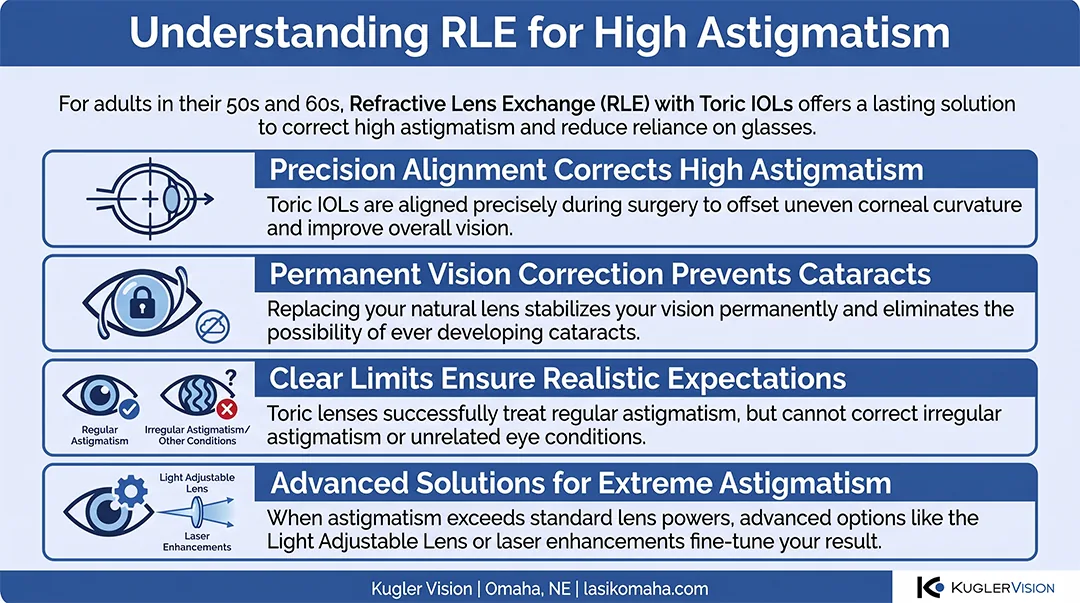
During RLE, we remove your eye’s natural lens and replace it with an intraocular lens. A toric IOL has different powers built into different parts of the lens, which offsets the uneven curvature of your cornea. Placement matters, because a toric lens has to sit at a specific angle to line up with your astigmatism. Our surgeons plan that orientation before surgery and use alignment technology in the operating room to position the lens accurately. Once it settles into place, the toric lens is designed to stay there and provide clear vision without a corrective lens. Because RLE also removes the natural lens, it eliminates any astigmatism that lens was contributing, and you will never develop a cataract in that eye.
What Can a Toric IOL Do for Your Vision?
A toric IOL can significantly reduce or eliminate regular corneal astigmatism, which improves visual acuity and reduces your dependence on glasses and contacts. For many of our patients, the difference is noticeable within the first few days. A toric lens can:
- Correct astigmatism and your overall prescription together: The same implant addresses near-sightedness or farsightedness along with your astigmatism.
- Sharpen your distance vision: Driving, sports, and screen work often become easier without glasses.
- Help with presbyopia: Toric versions of multifocal and extended depth of focus lenses can also improve near vision for reading.
- Provide a lasting correction: An artificial lens does not stiffen or cloud with age the way your natural lens does.
- Prevent cataracts: With the natural lens removed, cataract surgery will not be needed later in life.
What Can’t a Toric IOL Do?
A toric IOL cannot correct irregular astigmatism, and it may not fully correct very high amounts of astigmatism on its own. Understanding these limits ahead of time is part of how we set realistic expectations at Kugler Vision.
- Irregular astigmatism: Toric lenses are designed for regular, symmetrical astigmatism. Conditions such as keratoconus or corneal scarring create an uneven surface that an intraocular lens cannot fully correct, and a specialty contact lens may still provide the best visual acuity in those cases.
- Astigmatism beyond the lens range: Toric IOLs come in a set range of powers. Some eyes have more astigmatism than a single lens can neutralize, which can leave a small amount of residual blur.
- Automatic near vision: A standard monofocal toric lens is set for one focal distance. Without a presbyopia-correcting design, you will likely still need readers for close work.
- Other eye conditions: A toric lens does not treat dry eye, retinal disease, or other concerns that can affect the quality of your vision.
Am I a candidate?
Take our quick vision quiz. Over 80% of patients who were told ‘no’ elsewhere find a solution here.
2 Minutes
How Do We Measure Astigmatism Before RLE?
Accurate measurements are the foundation of a great toric IOL result, which is why every RLE patient at Kugler Vision begins with our EyeAnalysis™. Corneal topography maps the curvature across the entire surface of your cornea and shows whether your astigmatism is regular or irregular. Additional imaging measures the front and back surfaces of the cornea, along with the length of your eye, so we can calculate the right lens power and axis. We compare those findings with your current eyeglass prescription and your contact lens history. If you wear contacts, we will ask you to stop wearing them for a period before testing, since contact lenses can temporarily change the shape of the cornea and affect your measurements.
Will I Still Need Glasses After RLE With a Toric Lens?
Many patients enjoy freedom from glasses for most daily activities after RLE, but the answer depends on the lens design you choose. If you currently wear a progressive lens to see both distance and near, a toric multifocal or extended depth of focus IOL may reduce your need for glasses at both ranges. If you choose a monofocal toric lens, you can expect clear distance vision and will probably use reading glasses for menus, phones, and books. Some patients prefer Blended Vision, where one eye is set for distance and the other for near. Even with a presbyopia-correcting lens, a few people keep a light pair of readers for fine print in dim lighting. During your consultation, we will talk through your hobbies, work, and daily routine so the lens you choose fits the way you actually use your eyes.
What If My Astigmatism Is Too High for a Toric Lens Alone?
When astigmatism exceeds what a single toric lens can correct, we have additional tools to help you reach your vision goals. One option is the Light Adjustable Lens, which allows us to fine-tune your prescription, including astigmatism, after surgery using UV light treatments in the office. Another option is a laser enhancement with LASIK or PRK once your eye has fully healed, which can refine any remaining refractive error. Because Kugler Vision was the first practice in Nebraska and Iowa to offer the full range of modern vision correction procedures, we can combine these approaches when one procedure alone is not enough. This flexibility gives patients with high astigmatism more paths to the result they want.
Who Is a Good Candidate for RLE With a Toric IOL?
Good candidates are typically in their mid-50s or older, have regular astigmatism, and want to reduce their dependence on glasses and contacts. RLE is often a strong fit for people who are noticing presbyopia, have a high prescription, or were told they are not a candidate for laser vision correction because of their prescription or corneal thickness. You may be a good candidate if you:
- Are in your mid-50s or older and starting to struggle with reading or close-up tasks
- Have moderate to high regular astigmatism confirmed by corneal topography
- Want a long-term solution that also prevents future cataracts
- Have healthy eyes overall, with any dry eye or surface issues treated before surgery
Younger patients whose natural lens still focuses well are often better served by options such as EVO ICL, SMILE, or LASIK. Our team will review every option with you so you can choose with confidence.
Why Choose Kugler Vision for RLE and Astigmatism Correction?
Kugler Vision focuses exclusively on vision correction, and our surgeons bring advanced training and experience to every refractive lens exchange. Dr. Lance Kugler is a fellowship-trained refractive surgeon and published researcher, and Dr. Drew Dickson brings extensive surgical expertise to our team. Both are Fellows of the World College of Refractive Surgery & Visual Sciences. Our EyeAnalysis™ testing, careful lens planning, and access to every modern lens technology allow us to recommend the right toric IOL for your eyes and your lifestyle. We also take time to explain what your lens can and cannot do, so you know what to expect at every stage of your experience with us.
Find Out What a Toric IOL Can Do for Your Eyes
If high astigmatism has kept you tied to glasses or contacts, refractive lens exchange with a toric IOL may offer the clear, lasting vision you have been looking for. Schedule a private consultation with Kugler Vision in Omaha to learn whether you are a candidate and which lens options fit your goals. Book your consultation online or call us at (402) 558-2211.
Medically Reviewed By:
Drew Dickson, MD, Board-Certified Ophthalmologist
Fellowship-Trained Refractive Surgeon
Last reviewed October 15, 2026

Lance Kugler, MD, is a specialist in LASIK and vision correction surgery and CEO of Kugler Vision. A proud Omaha native, he is passionate about improving lives through clear vision. Dr. Kugler serves on several national boards, and his practice is recognized internationally as a center of excellence. Dr. Kugler is one of the original founders of the Refractive Surgery Alliance, an international organization comprised of over 350 of the world’s leading vision correction surgeons; he also served as its first president. In 2019, Dr. Kugler was selected as a TEDx speaker, and delivered a talk in Omaha about the worldwide epidemic of nearsightedness and refractive solutions. Dr. Kugler is an Associate Professor of Refractive Surgery at the University of Nebraska Medical Center’s Truhlsen Eye Institute, has been published in many medical journals, and participates in numerous clinical studies to advance the field of vision correction surgery. Additionally, Dr. Kugler is proud to be a Board Certified Fellow of the World College of Refractive Surgery & Visual Sciences. Dr. Kugler and his wife are proud parents to five active kids. When he has a spare moment, he enjoys skiing, tennis, travel, and fine coffee.