How Your Eyes Work
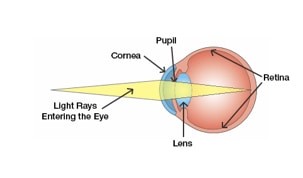
Blurry vision can be attributed to several causes, and they stem from how the eye works and how it has developed. The eye is a tiny organ that measures about an inch long and weighs about 1/4 of an ounce. It is part of a complex system that translates light into images. Light enters your eye through the cornea and into the pupil. The pupil is the black hole in the middle of the iris, which is the colored part of the eye. Behind the iris is the eye’s natural lens. It focuses the light onto the retina. The retina is the inside layer at the back of the eye, and contains cells that are sensitive to light. The image is then converted into electrical impulses that are sent through the optic nerve at the back of the eye to the brain.
All of this happens continuously and instantly to give you clear vision from near to far distances. But eyes don’t always work perfectly. Their exact size and shape affect how well they focus light. These differences can cause some people to have refractive errors such as myopia (nearsightedness), hyperopia (farsightedness), or astigmatism. In addition, over time, everyone loses the ability to focus on near objects. This is a refractive condition known as presbyopia, or blurry near vision, and is the first stage or dysfunctional lens syndrome (DLS). If uncorrected, DLS will progress. DLS stage 3 is a cataract.
Myopia

- Commonly known as nearsightedness
- Near objects are clear, but objects at a distance are blurry
- It is hard to focus on an object or detail far away, or across the room
- Occurs when the cornea (front surface of the eye) is too rounded or steep, or the eyeball is too long
Hyperopia

- Commonly known as farsightedness
- Objects at a distance are clear, but objects up close are blurry
- Occurs when the cornea is too flat or the eye is too short
- Hyperopia, or farsightedness, differs from presbyopia in that hyperopia is caused by an irregularly shaped eye that prevents light from properly lining up on the retina, and is not necessarily an age-related condition
Astigmatism

- Light coming into the eye is focused inconsistently
- All objects are stretched or distorted
- Occurs when the cornea has an irregular oval shape
- Can occur simultaneously with nearsightedness or farsightedness
The 3 Stages Of DLS
Over time, the eye’s natural lens loses its ability to focus, progressing through three clinical stages collectively known as Dysfunctional Lens Syndrome (DLS). Understanding which stage you’re in helps us recommend the right vision correction option.
01
Presbyopia
- Near vision loss that starts in your 40s and 50s
- The lens becomes too stiff to effectively focus up close
- Print and nearby objects become blurry
02
Advanced Presbyopia
- Typically begins affecting you in your 50s
- The natural lens continues to yellow
- Reduces clarity of both distance and near vision
03
Cataracts
- Typically affects you in your 60s and beyond
- The lens has become cloudy enough to significantly affect vision
- Treatment is necessary to restore the quality of your sight