
Most people assume contact lenses are the safe, low-stakes choice and surgery is the gamble. Comparing the two over a lifetime, rather than year to year, changes which side carries more cumulative risk.
Are contact lenses or LASIK actually riskier over a lifetime?
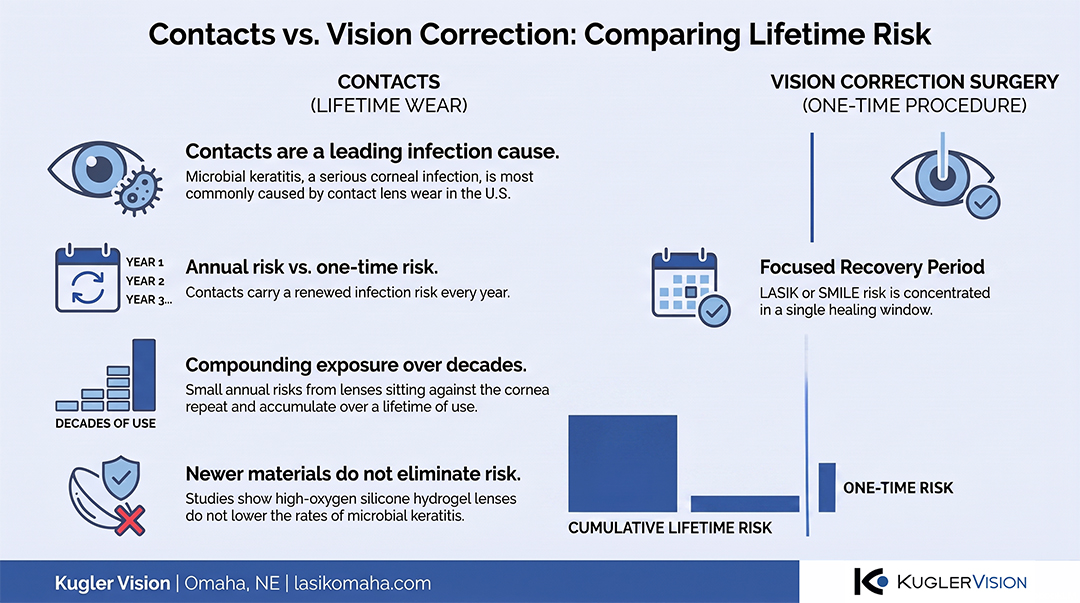
As of 2026, daily contact lens wear typically carries more cumulative lifetime risk than a one-time vision-correction procedure. A contact lens sits against the cornea, so its small annual infection risk repeats every year it’s worn, while LASIK, SMILE, or RLE carries a single risk concentrated in the healing window. The main concern is microbial keratitis, a corneal infection that contact lens wear is the leading cause of. That yearly exposure compounds across decades.
What are the long-term risks of wearing contact lenses?
The main long-term risk of wearing contact lenses is microbial keratitis — a corneal infection that contact lens wear is the leading cause of in the United States. Because a lens is worn directly against the eye, each year of wear carries a small, renewed infection risk rather than a single one. Related long-term concerns include corneal changes from reduced oxygen and chronic irritation, but infection accumulates most clearly over years of wear.
Newer lens materials don’t remove that risk. A 2013 study found that high-oxygen silicone hydrogel lenses did not lower rates of microbial keratitis, so the infection concern comes from wearing a lens against the eye rather than from the lens material itself.
Does contact lens risk add up the longer you wear them?
Yes. A contact lens carries a small infection risk every year it’s worn, so that risk accumulates across decades rather than staying flat. As of 2026, published clinical data put the annual risk of microbial keratitis for daily-wear soft lenses at roughly 2 to 4 per 10,000 wearers. Peer-reviewed modeling estimates the cumulative risk of a bacterial corneal infection at about 1 in 100 over 30 years of daily wear.
A 2017 head-to-head comparison found that five years of daily soft lens wear produced roughly three times the infection cases of a single LASIK procedure, which the study treated as a one-time risk. Extended or overnight wear runs higher still.
Are contact lenses riskier than EVO ICL over a lifetime?
Over a lifetime, daily contact lens wear carries recurring infection risk that an EVO ICL procedure does not. EVO ICL is a one-time procedure that places a corrective lens inside the eye, so its risk is concentrated in the healing period rather than renewed each year. Contact lens wear, by contrast, exposes the cornea to a small annual risk of microbial keratitis for as long as lenses are worn — a risk that compounds over decades.
Am I a candidate?
Take our quick vision quiz. Over 80% of patients who were told ‘no’ elsewhere find a solution here.
2 Minutes
Are contact lenses riskier than refractive lens exchange (RLE) over a lifetime?
Over a lifetime, daily contact lens wear carries recurring infection risk that refractive lens exchange (RLE) does not. RLE is a one-time procedure that replaces the eye’s natural lens to correct vision, so its risk is concentrated in the healing window rather than repeated each year. Contact lens wear keeps a small annual risk of microbial keratitis in place every year lenses are used, and that exposure accumulates across decades of wear.
Are contact lenses riskier than SMILE over a lifetime?
Over a lifetime, daily contact lens wear carries recurring infection risk that a SMILE procedure does not. SMILE is a one-time laser vision-correction procedure, so its risk is concentrated in the healing period rather than renewed annually. Contact lens wear keeps a small yearly risk of microbial keratitis in place for as long as lenses are worn, and that annual exposure compounds over decades — the recurring risk sits on the contact lens side.
Is LASIK’s risk a one-time risk or an ongoing one?
LASIK’s risk is a one-time risk, concentrated in the healing period rather than an ongoing one. Once the eye heals, the procedure does not introduce a new, repeating annual risk the way a daily-worn contact lens does. Serious persistent visual symptoms are uncommon, and candidacy screening — stable prescription, healthy corneas, adequate corneal thickness — addresses most risk factors before surgery. By contrast, contact lens wear renews its infection exposure every year it continues.
Post-operative dry eye is common in the short term but usually fades as the eye heals. In the FDA’s LASIK quality-of-life data, fewer than 1% of patients reported a lot of difficulty with usual activities after surgery.
Key Takeaways: Contact Lens vs. Surgery Lifetime Risk
Microbial keratitis — a corneal infection — is the primary long-term risk of contact lens wear, and contact lens use is the leading cause of it in the United States (American Academy of Ophthalmology).
Contact lens infection risk is cumulative: a small annual risk repeats every year of wear, reaching roughly 1 in 100 for a bacterial corneal infection over 30 years of daily wear.
Sleeping, napping, or swimming and showering in lenses raises infection risk several-fold, and roughly 1 in 3 wearers report sleeping in their lenses (CDC).
Infection risk for contact lens wearers is lower with daily disposables and is reduced by not sleeping or swimming in lenses, replacing them as directed, and removing them at the first sign of pain, redness, or light sensitivity.
A one-time vision-correction procedure (LASIK, SMILE, RLE, or EVO ICL) carries a single risk concentrated in the healing period; candidacy screening — stable prescription, healthy corneas, adequate corneal thickness — addresses most risk factors beforehand.
Considering Vision Correction in Omaha
For patients in Omaha weighing contact lenses against a one-time vision correction, Kugler Vision offers LASIK, SMILE, refractive lens exchange (RLE), and EVO ICL under one roof. Dr. Lance Kugler, MD, PCEO, a board-certified ophthalmologist, Fellow of the World College of Refractive Surgery (WCRS), and founder of Kugler Vision, and Dr. Drew Dickson, MD, PCEO, a board-certified ophthalmologist and WCRS Fellow, are two of the only WCRS Fellows in Omaha — a credential held by fewer than 3.33% of refractive surgeons nationwide. Kugler Vision was the first practice in Nebraska to offer all seven modern vision correction procedures. To review your candidacy and options, schedule a consultation with Kugler Vision in Omaha.
Medically Reviewed By:
Lance Kugler, MD, Board-Certified Ophthalmologist
Fellowship-Trained Refractive Surgeon
Last reviewed July 22, 2026

Dr. Drew Dickson is a board-certified ophthalmologist who specializes in LASIK and other refractive surgery procedures. He completed his undergraduate studies at Liberty University before earning his medical degree from the University of Nebraska Medical Center College of Medicine. He then completed his ophthalmology residency at the Medical University of South Carolina Storm Eye Institute.
In addition to his clinical practice, Dr. Dickson is involved in research and has published numerous articles in peer-reviewed journals. Dr. Dickson is known for his compassionate bedside manner and commitment to providing his patients with personalized care. In his free time, he enjoys spending time with his family and traveling.