
LASIK recovery is faster than most people expect. The majority of our patients see clearly the next morning and are back to everyday life within a day or two. Here is what healing actually looks like, what is normal along the way, and what we ask you to do to protect your result.
What Happens to Your Eye During LASIK Recovery?
During LASIK, a laser creates a thin flap in the outer layer of the cornea, the clear front surface of the human eye. A second laser reshapes the tissue beneath it, and the flap is repositioned, where it seals naturally. No stitches, and the eye surgery takes under 10 minutes per eye. Because the outermost corneal layer stays largely intact, healing is measured in days rather than weeks, and most patients describe the sensation afterward as dryness rather than pain.
How Long Does LASIK Recovery Take?
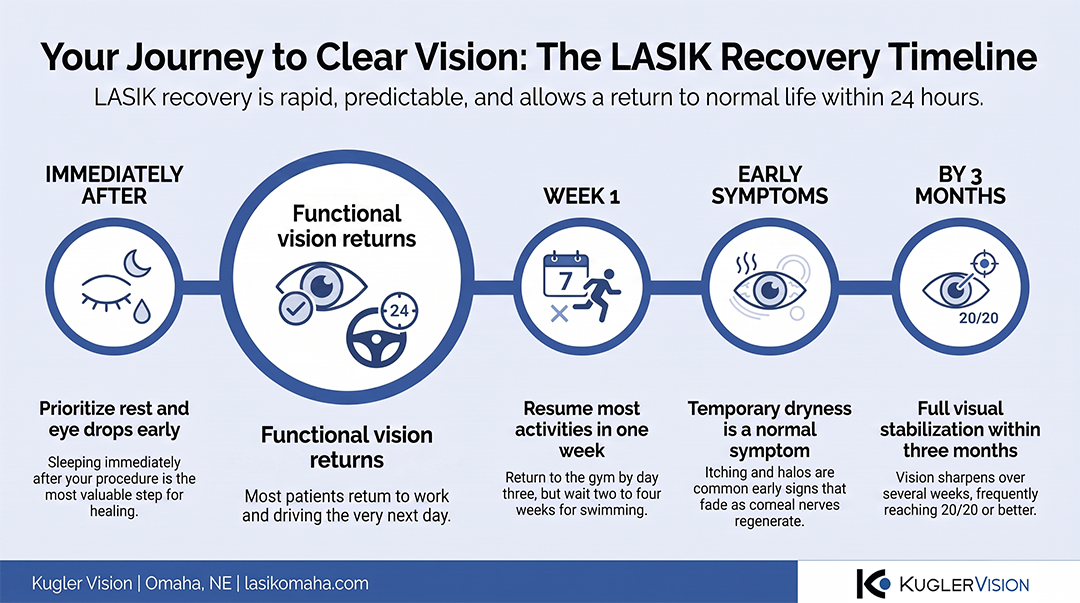
Most patients recover functional vision within 24 hours and return to work and driving the next day. Vision continues to sharpen over the following weeks and fully stabilizes at about three months.
The first few hours Go home and sleep. This is the most valuable thing you can do all day. Your vision will be hazy and watery, and your eyes may feel gritty as the numbing eye drops wear off. Most patients notice their vision is already clearer before this nap, and dramatically clearer after it. Wear the protective shield we send you home with while you sleep for the first several nights so you cannot rub your eyes unconsciously.
Day 1 Most patients wake up seeing clearly and come in for a brief eye examination, where we check your flap position and measure your visual acuity. The majority are cleared to drive and return to work the same day.
Week 1 Vision continues to sharpen. Mild dryness, occasional blurriness, and light sensitivity are the most common signs and symptoms, and they fade steadily. Medicated eye drops continue through this window.
Month 1 Restrictions lift. Night halos diminish, dryness improves, and your visual perception settles into something that feels natural rather than new.
Month 3 and beyond Vision stabilizes and refines. By this point most patients have reached their best visual acuity, frequently 20/20 or better. LASIK permanently reshapes the cornea, so once healed on a stable prescription, your correction is designed to last.
What Symptoms Are Normal During LASIK Recovery?
Knowing what to expect removes most of the anxiety from LASIK recovery.
Dryness The most common experience after LASIK. Creating the flap temporarily interrupts corneal nerves that signal your eye to produce tears, so your eyes make fewer of their own for a period. This resolves as those nerves regenerate.
Light sensitivity (photophobia) Bright rooms and headlights may feel harsh for several days. Sunglasses solve most of it, and we recommend wearing them outdoors through your first week.
Mild itch Normal, and not a warning sign. What matters is that you do not act on it. Rubbing is the one thing that can genuinely disrupt a healing flap. Use artificial tears instead.
Halos and glare at night Common early, and they resolve as the cornea settles and the normal inflammation of healing subsides.
Fluctuating vision Clear in the morning, softer by evening. Your eyes are adjusting.
If you experience genuine pain rather than dryness, sudden worsening of vision, increasing redness or discharge, or any blow to the eye, call us right away. Complications are rare and the signs are not subtle.
How Do Eye Drops Support LASIK Recovery?
Eye drops do two jobs during LASIK recovery, and they start before your procedure even begins. Anesthetic drops are applied at the outset of your eye surgery so that you feel no pain while the laser works, which is why most patients report only a sense of mild pressure.
Afterward, you will use medicated eye drops for one to two weeks. These promote a comfortable recovery and keep your eyes well lubricated throughout the healing process, which matters because your eyes temporarily produce fewer of their own tears while the cornea settles. We will send you home with a written schedule specific to your eyes, and following it closely is the part of your recovery most within your control. Set reminders for the first week.
Artificial tears are also your best resource against the urge to rub. When an eye feels dry or itchy, reach for drops rather than your hands.
Am I a candidate?
Take our quick vision quiz. Over 80% of patients who were told ‘no’ elsewhere find a solution here.
2 Minutes
When Can You Return to Normal Activities After LASIK?
Your surgeon will confirm your specific timeline at your Day 1 visit. In general:
Work, screens, and driving resume on Day 1 for most patients, once we confirm your vision meets the legal standard. Screens do not harm your eyes, but they suppress your blink rate and make dryness worse, so take breaks and keep artificial tears at your desk.
Exercise resumes in one to three days for walking and light activity, and three to seven days for the gym and non-contact sports. Wear a headband, since sweat in the eye is the early concern. Any contact sport where a finger or ball could strike the eye waits about a month, with protective eyewear afterward.
Swimming and water is where we are most conservative, because water carries organisms that can cause a corneal infection while the flap is still sealing. Chlorinated pools wait about two weeks. A lake, river, ocean, or hot tub waits about a month, since warm and standing water are especially hospitable to bacteria. Given Omaha summers, tell us if a lake weekend is on your calendar and we will plan around it.
Eye cosmetics go back on after one to two weeks. Open fresh products rather than reaching for the mascara that predates your surgery, since older cosmetics harbor bacteria and sit millimeters from a healing cornea.
Travel and leisure resume quickly. Flying is fine within days, though cabin air is dry, so pack artificial tears.
Is Dry Eye Normal During LASIK Recovery?
Temporary dryness after LASIK is common. Persistent dry eye syndrome is not, and it is largely preventable through screening.
Many patients who develop lasting dryness had some degree of it beforehand, often masked by years of contact lens wear. That is why our EyeAnalysis™ evaluation measures tear film quality and ocular surface health alongside corneal topography before we recommend anything. If we find an underlying issue, we treat it first and perform your surgery once your eyes are healthy. That sequence is what keeps post-LASIK dryness temporary. If it does linger, we have effective options, from prescription therapy to punctal plugs. Tell us at any follow-up. This is solvable, not something you live with.
What Follow-Up Care Does LASIK Recovery Require?
We see you at one day, one week, one month, six months, and one year. At each visit your surgeon evaluates your flap, your ocular surface, your visual acuity, and your comfort. Attend every appointment, including the ones where you feel fantastic. The point of the schedule is to catch small things while they are still small.
Why Does Vision Fluctuate During LASIK Recovery?
Your vision will be dramatically better within 24 hours, good enough to drive and work, and it will keep improving for weeks after. What it will not be is perfectly stable on Day 1. The blur that comes and goes in week two is not a problem with your result. It is your cornea finishing its work. Patients who understand this find LASIK recovery genuinely easy.
LASIK Recovery at Kugler Vision
We are the first practice in Nebraska and Iowa to offer all 7 modern vision correction procedures, and that shapes recovery more than it might seem. Because we are not limited to one option, we only perform LASIK on eyes genuinely suited to it. When corneal topography, thickness, or tear film point elsewhere, we recommend SMILE, PRK, or EVO ICL instead. Matching the procedure to the eye is the first step in a comfortable recovery, and every patient is followed for a full year by the same team that performed the surgery.
The best LASIK recovery starts with the right diagnosis. Book a private EyeAnalysis™ consultation and we will show you exactly what your eyes need and what your healing will look like.
Book a Consultation | Call (402) 558-2211
Frequently Asked Questions
Does LASIK recovery hurt?
No. Most patients report a gritty, dry sensation for a few hours rather than pain. If you are experiencing real pain, call us, because that is not typical.
When can I wear glasses or contact lenses again?
You will not need corrective lenses for the prescription we treated. Sunglasses are encouraged from day one. Never put a contact lens back in during recovery unless a surgeon specifically instructs you to.
Is LASIK recovery different from PRK recovery?
Considerably. PRK involves no flap, so the corneal surface regenerates over several days of more noticeable discomfort and several weeks of blur. LASIK recovery is far faster, which is why it remains the most requested laser eye surgery in ophthalmology.
Medically Reviewed By:
Lance Kugler, MD, Board-Certified Ophthalmologist
Fellowship-Trained Refractive Surgeon
Last reviewed August 6, 2026

Lance Kugler, MD, is a specialist in LASIK and vision correction surgery and CEO of Kugler Vision. A proud Omaha native, he is passionate about improving lives through clear vision. Dr. Kugler serves on several national boards, and his practice is recognized internationally as a center of excellence. Dr. Kugler is one of the original founders of the Refractive Surgery Alliance, an international organization comprised of over 350 of the world’s leading vision correction surgeons; he also served as its first president. In 2019, Dr. Kugler was selected as a TEDx speaker, and delivered a talk in Omaha about the worldwide epidemic of nearsightedness and refractive solutions. Dr. Kugler is an Associate Professor of Refractive Surgery at the University of Nebraska Medical Center’s Truhlsen Eye Institute, has been published in many medical journals, and participates in numerous clinical studies to advance the field of vision correction surgery. Additionally, Dr. Kugler is proud to be a Board Certified Fellow of the World College of Refractive Surgery & Visual Sciences. Dr. Kugler and his wife are proud parents to five active kids. When he has a spare moment, he enjoys skiing, tennis, travel, and fine coffee.