
Most vision correction procedures are permanent by design. That is usually the point — and for most patients, it is exactly what they want.
EVO ICL offers something different. Not because permanence is a problem, but because some patients want the option to change course if their eyes or their life circumstances ever call for it. The lens sits behind the iris, corrects nearsightedness and astigmatism with precision, and can be removed by a surgeon if needed. Most patients never use that option. Knowing it exists changes how they feel about moving forward.
At Kugler Vision in Omaha, we offer EVO ICL alongside six other modern vision correction procedures — because the right answer looks different for every patient. For anyone who has hesitated on vision correction because the word “permanent” felt like a door closing rather than one opening, EVO ICL is worth understanding.
What Most People Get Wrong About Vision Correction
Most people approach refractive surgery with a single assumption locked in: that any procedure permanently alters their eyes. It’s an understandable conclusion, and it comes almost entirely from how familiar LASIK has become. When vision correction enters a conversation, LASIK tends to define the entire category in people’s minds. So if LASIK is permanent, the thinking goes, every form of eye surgery must be permanent too.
That assumption keeps a lot of people in glasses and contact lenses far longer than necessary — not because they aren’t ready to see clearly, but because they aren’t ready to make what feels like an irreversible commitment. A fundamentally different category of corrective eye surgery technology exists — a lens-based solution designed from the beginning with a built-in exit strategy.
What “Reversible” Actually Means with EVO ICL
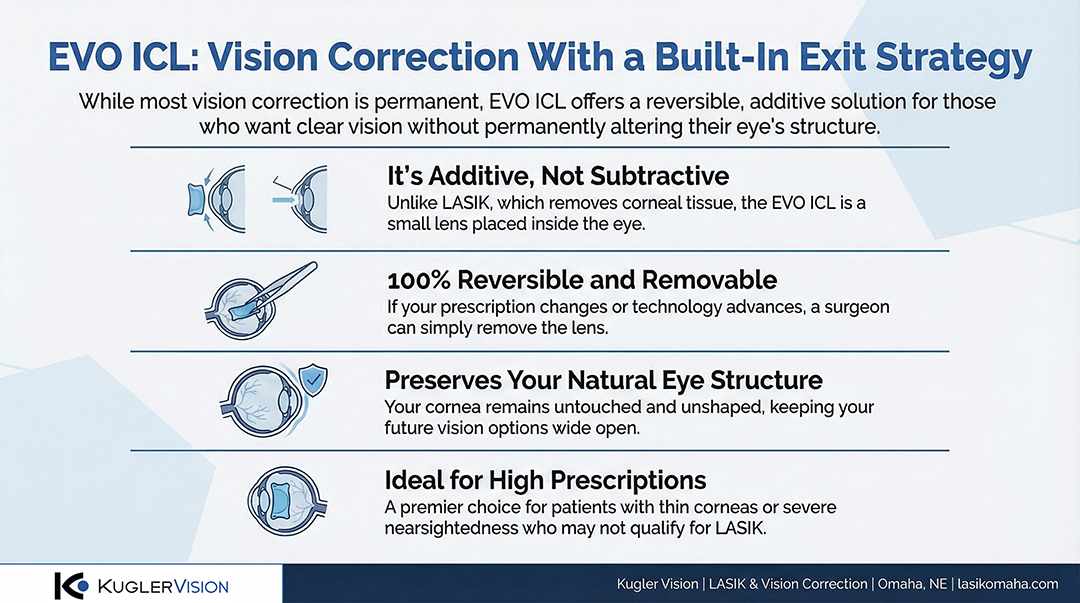
EVO ICL is a phakic intraocular lens — a small implant placed inside the eye, positioned between the iris and your natural lens. Unlike laser-based procedures, nothing is cut, reshaped, or permanently removed from the cornea. The lens is additive. It works alongside your eye’s existing structure rather than altering it.
Reversibility, in practical terms, means this: if you ever need or want the lens removed, a surgeon can perform that procedure. The eye returns to its pre-procedure state. The natural tissue remains untouched throughout the entire life of the implant, whether that’s five years or several decades.
We want to be clear about something important: lens removal is not a common outcome. The overwhelming majority of patients who choose EVO ICL never pursue removal. This is a safety net — not a likely path. But knowing that net exists changes the entire emotional calculus of the decision, and that matters.
LASIK Reshapes Your Cornea — Here’s Why That Matters
To understand why EVO ICL’s reversibility is significant, it helps to understand what makes LASIK permanent. LASIK uses a laser to reshape the cornea by removing corneal tissue. That tissue cannot regenerate or be replaced. The procedure works by permanently altering the cornea’s curvature to correct refraction, which changes how light focuses on the retina and improves visual acuity.
LASIK is a proven, effective form of refractive surgery — we offer it ourselves, and for many patients, it’s the right choice. But its permanence has real implications. Some patients find that if their eyeglass prescription shifts years later, options for additional correction are limited by how much corneal tissue remains viable. Others simply want the option to be able to explore what might come next in vision correction.
Think of it this way: LASIK is like sculpting marble — once the material is removed, it’s gone. EVO ICL is placing a precision corrective lens inside the eye. The structure underneath stays exactly as it was. This is not an argument against LASIK. It’s an argument for giving every patient the full picture before they decide.
The Psychology of Permanent Decisions (And Why It Keeps You in Glasses)
There’s a pattern we see often in ophthalmology consultations: people who have researched vision correction extensively, want freedom from glasses, and still can’t bring themselves to move forward. It’s a rational response to a situation where the stakes feel permanent and the unknowns feel too large.
Your eyes are the organ you depend on most for visual perception and daily function. The idea of doing something irreversible to them — even something with an excellent safety record — can trigger a protective hesitation that statistics alone won’t fully resolve. We understand that.
What we’ve found is that this hesitation often lifts when patients learn that EVO ICL isn’t the permanent commitment they assumed all eye surgery to be. The question shifts from “Am I ready to change my eyes forever?” to “Am I open to trying a solution I can reverse if I ever need to?” Those are very different questions — and the second one is much easier for most people to answer.
What Happens If You Change Your Mind? A Real Look at Lens Removal
If you ever decide you want the EVO ICL removed, that process involves a surgeon performing a straightforward outpatient procedure. It is not a reversal you can initiate on your own, and it is still a medical procedure that deserves proper consideration. What it is not is impossible, dramatic, or damaging to your eye.
The scenarios that occasionally lead patients to consider removal are entirely reasonable: a significant shift in prescription over time, the desire to pursue a different form of correction as technology continues to advance, or simply a personal preference. In each case, the underlying eye structure remains intact. The cornea has never been touched. Corneal topography measurements taken before your original surgery would still be valid. Your options stay open.
It’s also worth noting that EVO ICL does not interfere with future eye procedures if they become necessary later in life. Patients who go on to develop cataracts, for example, can still undergo cataract surgery. The implant does not close any doors.
Who the Reversibility Factor Matters Most For
Not every patient places the same weight on reversibility. But for certain individuals, this feature is genuinely important to the decision.
Younger patients managing myopia or near-sightedness, whose eyeglass prescription may still be shifting, often appreciate knowing they aren’t locked into a single correction for life. A prescription that changes by a dioptre or two over the next decade doesn’t have to mean starting from scratch.
People who were told they are not LASIK candidates — often because of thin corneas, high prescription ranges, or a history of dry eye syndrome — have historically felt that effective vision correction wasn’t available to them. EVO ICL was developed in part as a solution for exactly these patients, and the fact that it’s reversible makes it a stronger candidate option for people who’ve felt overlooked by traditional refractive surgery pathways.
Then there are the careful researchers — individuals who, regardless of astigmatism levels or candidacy factors, simply need to know they aren’t making a one-way decision before they can move forward.
Your Vision, Your Terms: Taking the Next Step
Choosing vision correction doesn’t have to mean surrendering control over your eyes. At Kugler Vision, that principle shapes how we approach every consultation. EVO ICL is built on something that matters deeply in ophthalmology: that a lens designed for long-term wear should still respect a patient’s right to change course.
The biocompatibility of the collamer material — including its built-in ultraviolet protection — means the implant is engineered to coexist with your eye’s biology indefinitely. But “indefinitely” is a choice you make, not a condition imposed on you. And that distinction is exactly what makes EVO ICL worth understanding before you assume all vision correction looks the same.
We’ve had patients come to Kugler Vision after years of avoiding eye surgery — not because they didn’t want better vision, but because no one had told them a reversible option existed. If that’s you, we’d like to change that.
Ready to explore a vision correction option that works with you? Schedule a consultation with Kugler Vision to find out if EVO ICL is right for your eyes.

Lance Kugler, MD, is a specialist in LASIK and vision correction surgery and CEO of Kugler Vision. A proud Omaha native, he is passionate about improving lives through clear vision. Dr. Kugler serves on several national boards, and his practice is recognized internationally as a center of excellence. Dr. Kugler is one of the original founders of the Refractive Surgery Alliance, an international organization comprised of over 350 of the world’s leading vision correction surgeons; he also served as its first president. In 2019, Dr. Kugler was selected as a TEDx speaker, and delivered a talk in Omaha about the worldwide epidemic of nearsightedness and refractive solutions. Dr. Kugler is an Associate Professor of Refractive Surgery at the University of Nebraska Medical Center’s Truhlsen Eye Institute, has been published in many medical journals, and participates in numerous clinical studies to advance the field of vision correction surgery. Additionally, Dr. Kugler is proud to be a Board Certified Fellow of the World College of Refractive Surgery & Visual Sciences. Dr. Kugler and his wife are proud parents to five active kids. When he has a spare moment, he enjoys skiing, tennis, travel, and fine coffee.